

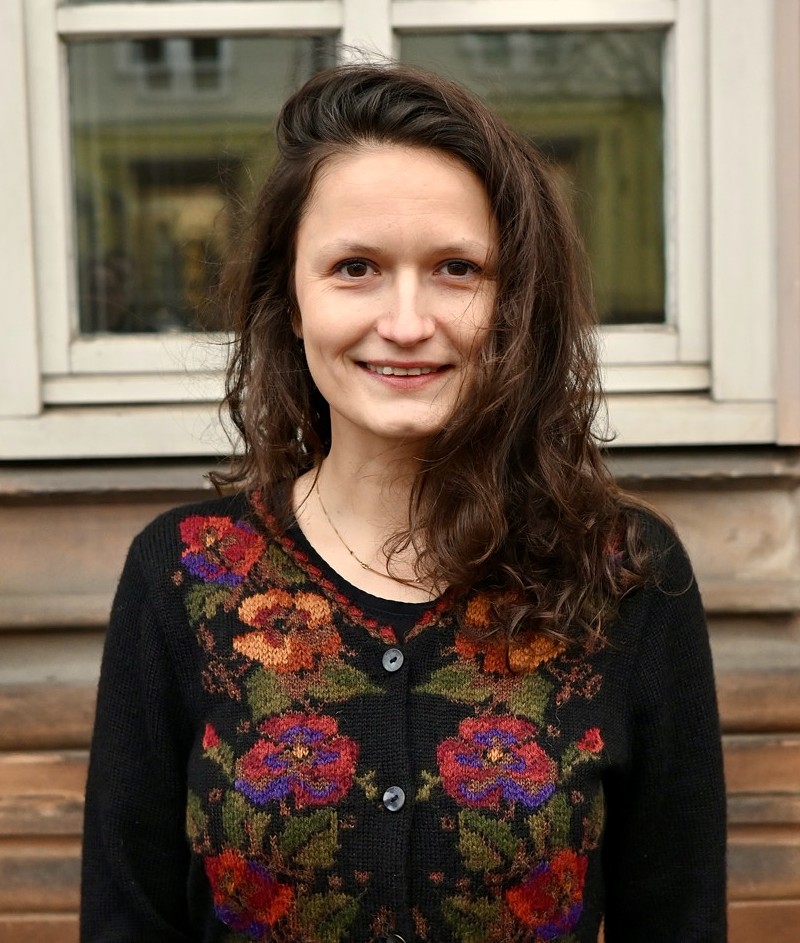
Research Associate
Dr. Kristine Andra Avram
K. Andra Avram’s research lies at the intersection of peace and conflict studies, narratology, and the social sciences. It examines processes of meaning-making in the context of past and present political violence and state repression, often from multiple perspectives.
Within Conflicts.Meanings.Transitions, she works as a postdoctoral researcher on the sub-project on corporate responsibility. There, she investigates how differently positioned actors attribute, demand, or reject responsibility on the part of arms manufacturers, and how competing understandings of responsibility are negotiated. She is also a member of the C3 Research Centre at the University of Bayreuth, a co-spokesperson of the Working Group “Critical Peace Research” of the Association for Peace and Conflict Studies (AFK) and a research associate at the Research Center “Transformations of Political Violence” (TraCe).
RESEARCH AREAS
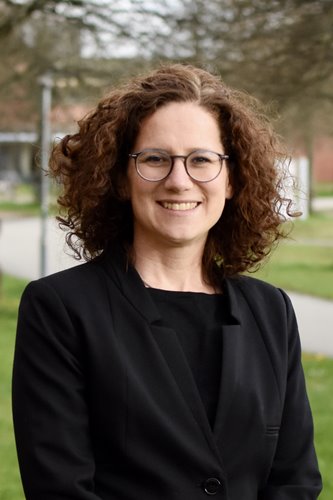
(Photo: Niklas Reinhart)
Principal Investigator
PD Dr. Julia Eichenberg
Dr. Julia Eichenberg is a Freigeist Fellow and lectures in Modern European History at the University of Bayreuth. Her research combines Eastern and Western European history as well as a history of international cooperation with the study of war and violence.
Within Conflicts.Meanings.Transitions she is Principal Investigator (PI) of a sub-project on paramilitary violence after World War I as well as, together with Prof. Dr. Jana Hönke, a sub-project on corporate responsibility for colonial violence. In addition, she is PI of the London Moment project (2014-2023, Volkswagen Foundation), and spokesperson of the German Association for Historical Peace and Conflict Research (AKHF).
Research Areas
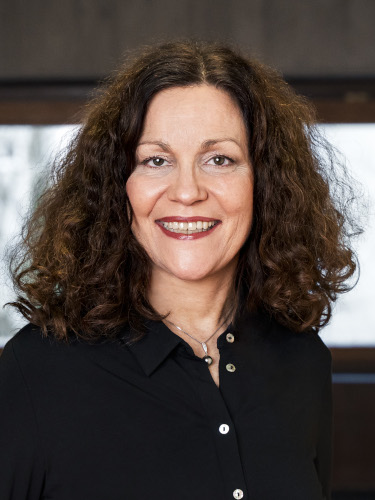
(Photo: Johanna Weber)
Principal Investigator
Prof. Dr. Isabel Heinemann
Isabel Heinemann is Director of the Institute for Contemporary History Munich–Berlin and holds a chair for contemporary history at the Ludwig-Maximilians-University Munich (LMU). Before coming to Munich in October 2025, she taught at Universities of Bayreuth, Münster, Cologne, and Freiburg. She is a specialist for the history of Germany and the United States in the 20th century. She has published widely on the history of National Socialism and the Holocaust as well as gender history and the history of the family. Currently, she is working on a book project that proposes a gendered history of Germany past 1945 and another research project on “European Families after Occupation” post WWII.
Research Areas
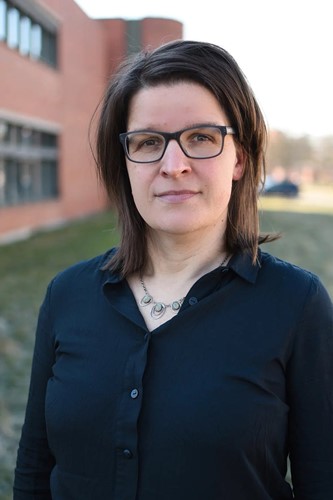
(Photo: UBT/J. Rennecke)
Principal Investigator
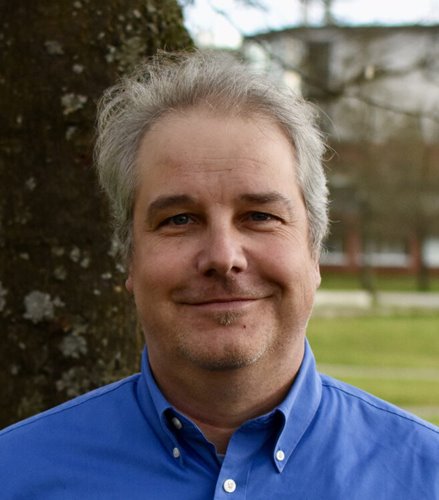
Prof. Dr. Jana Hönke
Jana Hönke holds a chair at the University of Bayreuth with a focus on Global Political Sociology and Peace and Conflict Studies. Her research addresses how governance practices are exercised and contested.
In Conflicts.Meanings.Transitions she co-leads a sub-project with Dr. Julia Eichenberg on corporate responsibility for colonial violence. She is also the director of INFRAGLOB (ERC), a sub-project within Postcolonial Hierarchies (BMFTR), and the DFG project Crafting the Space to govern. Furthermore, Jana Hönke is Director of the Conflict, Crisis, and Change (C³) Research Center at the University of Bayreuth and Board member of the Deutsche Stiftung Friedensforschung (DSF).
Research Areas
(Photo: Niklas Reinhart)
Associated Researcher (former Co-Coordinator)
PD Dr. Florian Kühn
Florian Kühn is Senior Researcher in Peace and Conflict Research at the University of Gothenburg and previous co-coordinator of the Conflicts.Meanings.Transitions research network. He has more than two decades of experience in studying violence and its political organisation, within the state or outside state structures. His research mainly focuses on the interactions of “local” social orders and international interventions.
Research Areas
Research Associate
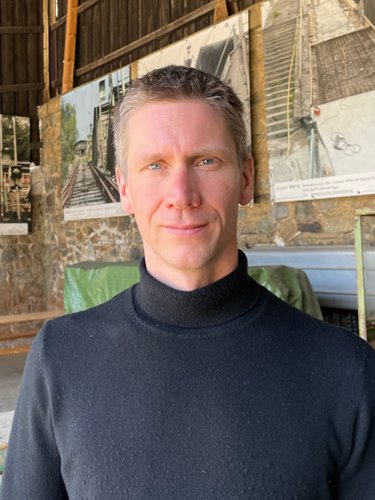
Dr. Christian Methfessel
Christian Methfessel is a research fellow at the Institute of Contemporary History Munich-Berlin (IfZ). His research focuses on the history of the international order since 1945.
In “Deutungskämpfe im Übergang” he is working on the sub-project “Menschen, Rechte, Identität(en). Die jugoslawischen Nachfolgekriege und gesellschaftliche Deutungskämpfe im Europa der frühen 1990er Jahre.” In addition, he is working on a project on the history of annexations and secessions in the age of the global Cold War.
Research Areas
Research Associate
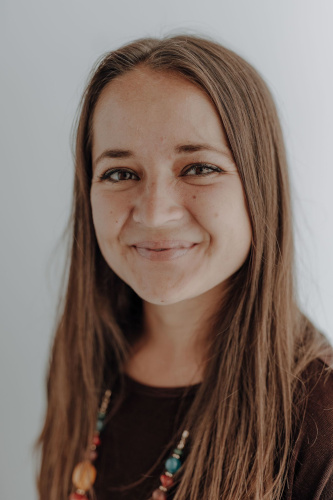
Dr. Christina Pauls
Christina Pauls is a research associate at the Chair of Political Science, Peace and Conflict Research at the University of Augsburg. She is also the managing director of the Augsburg Peace Transfer Center. Her current research focuses on competing interpretations of sexualized violence, with particular attention to debates in Germany since 2010 about how to confront and address the country’s past.
Research Areas
(Photo: Peter Kolb)
Coordinator
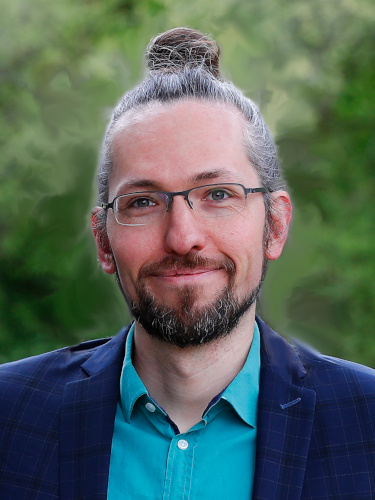
Dr. Jan Sändig
Jan Sändig is a research associate at the Chair for Sociology of Africa (University of Bayreuth) and coordinator of both the Conflicts.Meanings.Transitions research network (previously co-coordinator, 2022–26) and the C³ – Conflict, Crisis, and Change Research Center at the University of Bayreuth.
His research centers on social movements and contentious politics in Subsaharan Africa. Particularly, he has been studying resource and environmental conflicts, especially regarding large-scale investment projects in agriculture and mining. His recent work focuses on climate conflicts and activism for sustainable futures.
Reseach Areas
Principal Investigator
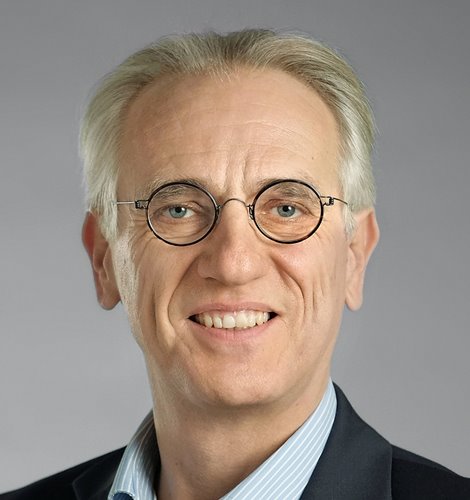
Prof. Dr. Christoph Weller
Christoph Weller is head of the Department of Political Science, Peace and Conflict Studies at the Faculty of Philosophy and Social Sciences at the University of Augsburg. His research focuses on conflict research, especially its methodology and practice orientation, among others related to communal conflict transformation, epistemologies of peace and participatory conflict research.
In the research network, he is primarily concerned with problems of social science peace and conflict research as well as theoretical-conceptual questions of interpretive struggles. In addition, he conducts research on the emergence and development of peace and conflict research in Germany.
Research Areas
Former team members
(Photo: Emily MacKenzie)
Principal Investigator
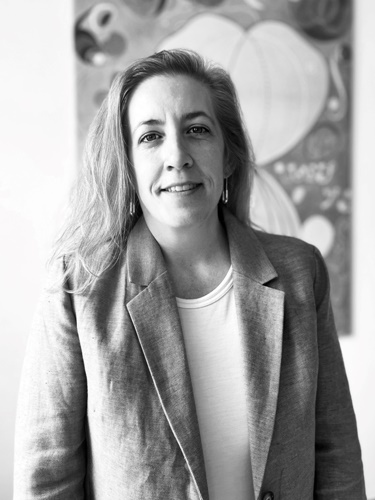
Prof. Dr. Simone Derix
Simone Derix holds the Chair of Modern and Contemporary History at the Friedrich-Alexander-Universität Erlangen-Nürnberg. Her research focuses on transnational actors, networks, transfers and perceptions in the 20th century.
Within Conflicts.Meanings.Transitions she led a sub-project on the interpretations of the Nuremberg Trials in the global South and the repercussions of these interpretations in Europe. She is co-editor of the online portal “Quellen zur Geschichte der Menschenrechte,” the series “Studien zur Internationalen Geschichte,” and the journal “Historische Anthropologie.”
Research Areas
Research Associate
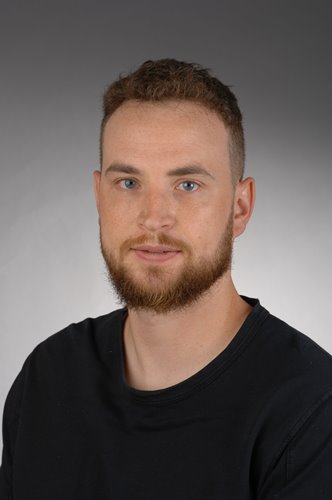
Johannes Lehmann, M.A.
Johannes Lehmann was a research associate in the Department of Modern and Contemporary History at the University of Augsburg. His research focuses, among other things, on the history and post-history of the National Socialist concentration camps. Together with Prof. Dietmar Süß, he was working on the sub-project “Politik der Versöhnung: Kirchen, Religion und Diktaturbewältigung nach 1945”.
Research Areas
Research Associate
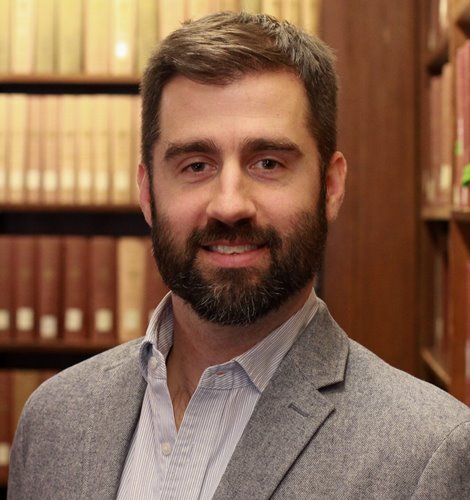
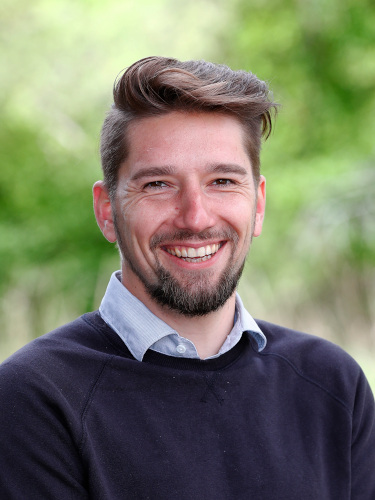
Dr. Bretton (Bret) McEvoy
Bret is a political scientist with a focus on international relations and peace and conflict studies. His research addresses how political actors interpret their roles in histories of injustice and engage their consequences through projects of accountability, denial and resistance.
In Conflicts.Meanings.Transitions he examined the entangled corporate responsibilities of arms manufacturers in (post)colonial violence.
Research Areas
(Photo: Peter Kolb)
Research Associate
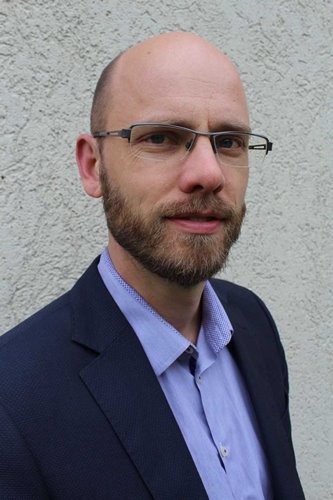
Alexander Schwarz, M.A.
Alexander Schwarz was a research associate at the University of Bayreuth. His research interests focus on nationalism, anti-Semitism and the Freikorps.
Within Conflicts.Meanings.Transitions he examined (supervised by PD Dr. Julia Eichenberg) the suppression of the Munich Soviet Republic. The study focused on the question of why the (Franconian) Freikorps and government troops unleashed violence in Munich in May 1919, which has since been known as the “White Terror”.
RESEARCH AREAS
Research Associate
PD Dr. Daniel Stahl
Daniel Stahl is a research associate at the Department of Modern and Contemporary History. He researches how legal norms were negotiated and enforced internationally and transnationally in the 20th century.
In his subproject, he focused on the significance of the Nuremberg Trials for transatlantic interpretive struggles for peace and justice. Using the Argentine-German example, he asked how references to “Nuremberg” shaped the interpretation of past experiences of violence in Argentina and how they affected the German discussion of the Nuremberg Trials.
RESEARCH AREAS
Principal Investigator
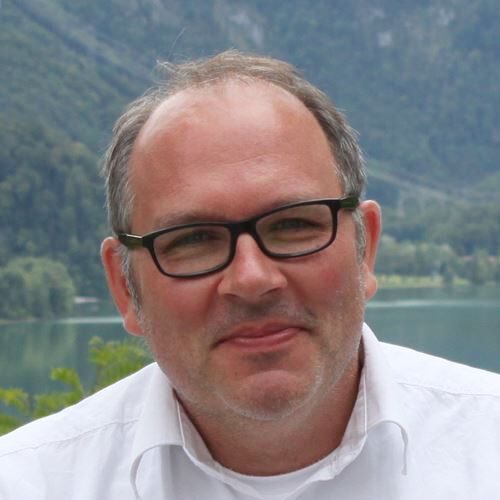
Prof. Dr. Dietmar Süß
Dietmar Süß is Professor of Modern and Contemporary History at the University of Augsburg. His research deals, among other things, with experiences of violence in the 20th century. He led the sub-project on the “Politik der Versöhnung: Kirchen, Religion und Diktaturbewältigung nach 1945”.
RESEARCH AREAS
(Photo: Anna Weichmann)
Research Associate
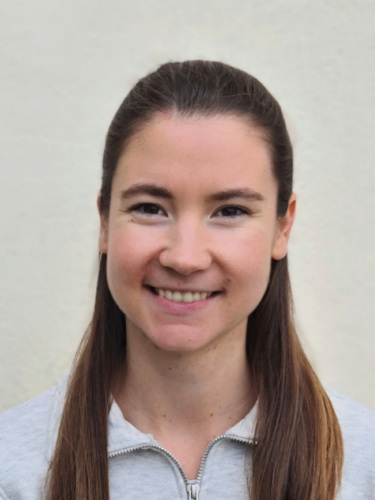
Anna Weichmann, M.A.
Anna Weichmann is a research associate at the Chair of Modern and Contemporary History at the University of Augsburg. Her research focusses on the aftermath of National Socialism and right-wing extremism. Together with Prof Dietmar Süß, she worked on a sub-project on ‘Meaning contestations over public space’.
Research areas
Principal Investigator
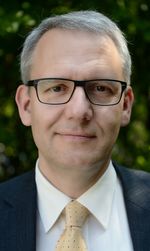
Prof. Dr. Andreas Wirsching
Andreas Wirsching was Director of the Institute of Contemporary History Munich-Berlin (IfZ) and Chair of Modern History at the Ludwig-Maximilians-Universität Munich. His research focuses, among other things, on globalization as well as German and European history in the 20th and 21st centuries.
He is a member of the Bavarian Academy of Sciences and Humanities and is, among other things, a member of the scientific advisory board of the House of European History in Brussels. In addition, he is one of the main editors of the edition “Akten zur Auswärtigen Politik der Bundesrepublik Deutschland” (AAPD), compiled by the IfZ on behalf of the German Foreign Office.
In “Interpretive Struggles in Transition” he led the IfZ-based sub-project “Menschen, Rechte, Identität(en). Die jugoslawischen Nachfolgekriege und gesellschaftliche Deutungskämpfe im Europa der frühen 1990er Jahre”.
Research Areas

Research Associate
Dr. Michaela Zöhrer
Michaela Zöhrer was a postdoctoral researcher at the University of Augsburg, Chair of Political Science, Peace and Conflict Studies. The diploma sociologist and doctor of social science focuses her current research on contemporary struggles over meaning in the area of conflict between identity politics and universalistic promises of participation.
In Conflicts.Meanings.Transitions she was also jointly responsible for academic and political education as well as promotion of young academics.

