

Interpretive struggles over international order
The research network examines historical and contemporary struggles over the meaning of international order. We ask what conceptions of order compete in these interpretive struggles, how they are institutionally embedded and challenged, and which configurations of power make such struggles possible in the first place.
Our starting point is the observation that, particularly in European politics, a (human-)rights-based, liberal, cooperative, and trade-oriented order is often regarded as indispensable. Consequently, existing alternatives are frequently overlooked or perceived merely as aberrations. Meanwhile, models of statehood and forms of societal organization are contingent and challenged by actors that put forward different normative and procedural conceptions.
The subprojects therefore analyze how the normative foundations of international politics are negotiated. In doing so, we bring together perspectives from contemporary history, peace and conflict studies, as well as other fields. The focus is on struggles over the meaning of statehood in the post-Soviet space after 1990, over the ambiguous position of Ukraine as both a post-Soviet and a European state, and over appropriate international structures in times of the climate crisis.
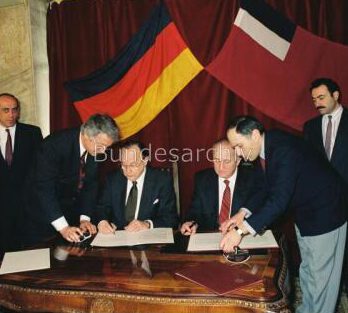
Germany’s foreign minister Hans-Dietrich Genscher (seated left) and Georgian foreign minister Alexander Chikvaidze sign in Tbilisi the establishment of diplomatic relations between the two countries (1992).
Source: Bundesarchiv, B 145 Bild-00098979 / Fotograf(in): Fassbender, Julia
The Dissolution of the Soviet Union and the Contested Post-Cold War Order
Dr. Christian Methfessel & Prof. Dr. Isabel Heinemann
Leibniz Institute for Contemporary History
Expanding on the previously conducted research on the Yugoslav Wars and the international order of the 1990s, this project examines British and German responses to the dissolution of the Soviet Union. In particular, it builds on the analysis of the renegotiation of international norms (such as territorial integrity, the right to self-determination, and minority rights) resulting from the violent breakup of the multi-ethnic Yugoslav federation. After the outbreak of the Yugoslav Wars, European politicians were anxious to prevent further escalations of violence on the European continent.
The dissolution of the Soviet Union, by comparison with the break-up of Yugoslavia a rather peaceful process in the early 1990s, seemed to point to a better, norm-based future for Europe. However, there were also conflicting developments, including the Russian-Ukrainian dispute over Crimea, the Transnistrian War following Moldova’s independence, Georgia’s struggle against South Ossetian and Abkhaz separatism, and the First Chechen War. By examining how the United Kingdom and Germany dealt with such conflicts, the study asks to what extent particular events were interpreted either as temporary setbacks or as fundamental challenges to the European peace order. Moreover, by combining the investigation of the dissolution of the Soviet Union with previous findings on the Yugoslav wars, this project aims to identify critical developments of the 1990s that can inform our understanding of contemporary struggles over the meaning of international norms and the European peace and security order.
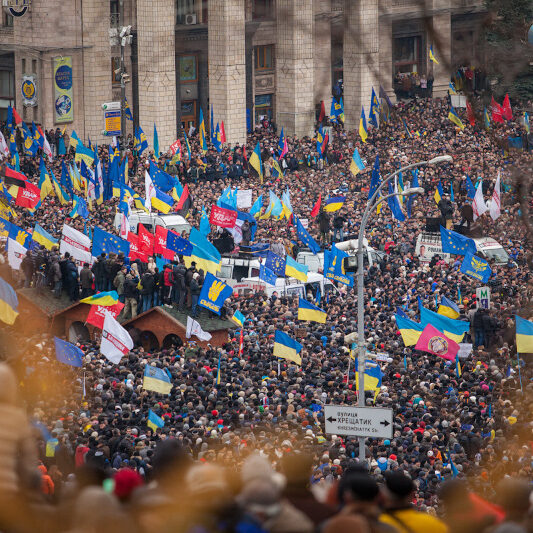
Euromaidan protests at Kyiv, December 2013
Source: Nessa Gnatoush
The Ambiguity of European Integration
PD Dr. Florian Kühn
School of Global Studies, University of Gothenburg
The project examines Ukraine’s development from a country initially perceived in European eyes as post-Soviet to a state with clear EU and NATO ambitions. Starting from the Orange Revolution (2004), a struggle over closer ties with Western Europe became evident. It centered on the question of how Ukrainian elites pursued a Western European course without completely severing relations with Russia. In doing so, they faced attempts at disambiguation: on the one hand, through Russia’s actions in territorial conflicts, arguments concerning the protection of minorities, and ultimately the annexation of Crimea; on the other, through European strategies aimed at fighting corruption, strengthening the rule of law, and furthering economic integration.
Building on the concept of ambiguity developed in the preceding project, this study analyzes parallel political interpretations and their influence on key EU decisions and the positions of Ukrainian partners. It reconstructs the dynamics of escalation in the conflict between two regional power blocs and examines room for manoeuvre. At the same time, the project develops practice-oriented foundations for a European postwar order and contributes to debates in International Relations, particularly on global ordering, new geopolitics, and the conceptual refinement of the ambiguity approach.
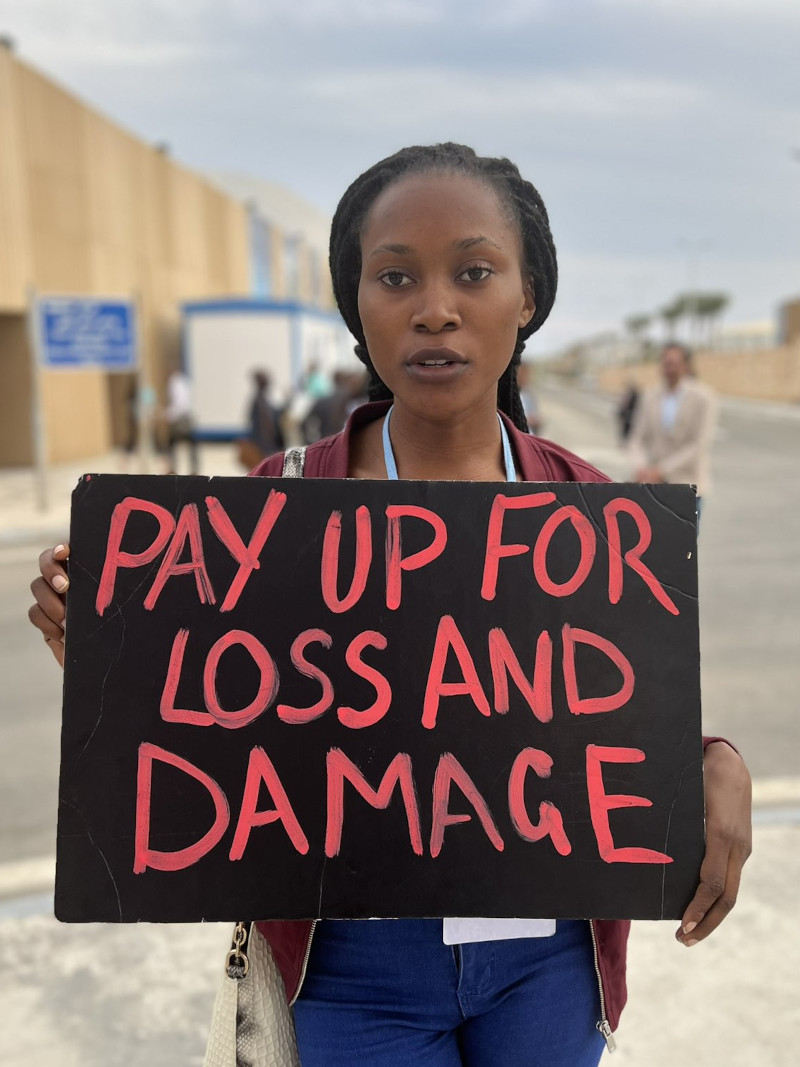
Ugandan climate activist Patience Nabukalu at the COP 2022
Source: Twitter/X
Interpretive Struggles over Climate Change
Dr. Jan Sändig & Prof. Dr. Jana Hönke
Chair for Sociology in Africa, University of Bayreuth
The project examines the role of African climate activists in struggles over climate change. It focuses on processes of negotiation arising between proponents of different development models: from fossil-based growth via “green” development based on renewable energy to calls for fundamental socio-ecological transformation and global climate justice.
Against this background, the project analyzes the visions and resonance of African climate activists. Although they advance morally powerful claims, their ideas have hardly resonated with publics and the climate movement in Western countries. To re-trace and explain this, the project applies the framing methodology and draws on research on vision-making and marginalization within social movements. Thereby, the study generates analytically, socially, and politically relevant insights into the conditions under which struggles over meaning can preserve or transform the international order.

