

Research approach – Conflicts.meanings.Transitions
Conflicts.Meanings.Transitions („Deutungskämpfe im Übergang“) examines how societies negotiate political and social change and the conditions under which such processes can contribute to peace. Such transitions may arise, for example, when political orders come under pressure or when societal ideas and expectations change. In these periods, political positions once considered “overcome” are often re-articulated and renegotiated alongside “new” perspectives. The involved actors compete to define the meaning of the past, using it to legitimize their positions in the present and shape the future. These struggles may escalate into violence, but they can also create opportunities to consolidate peace.
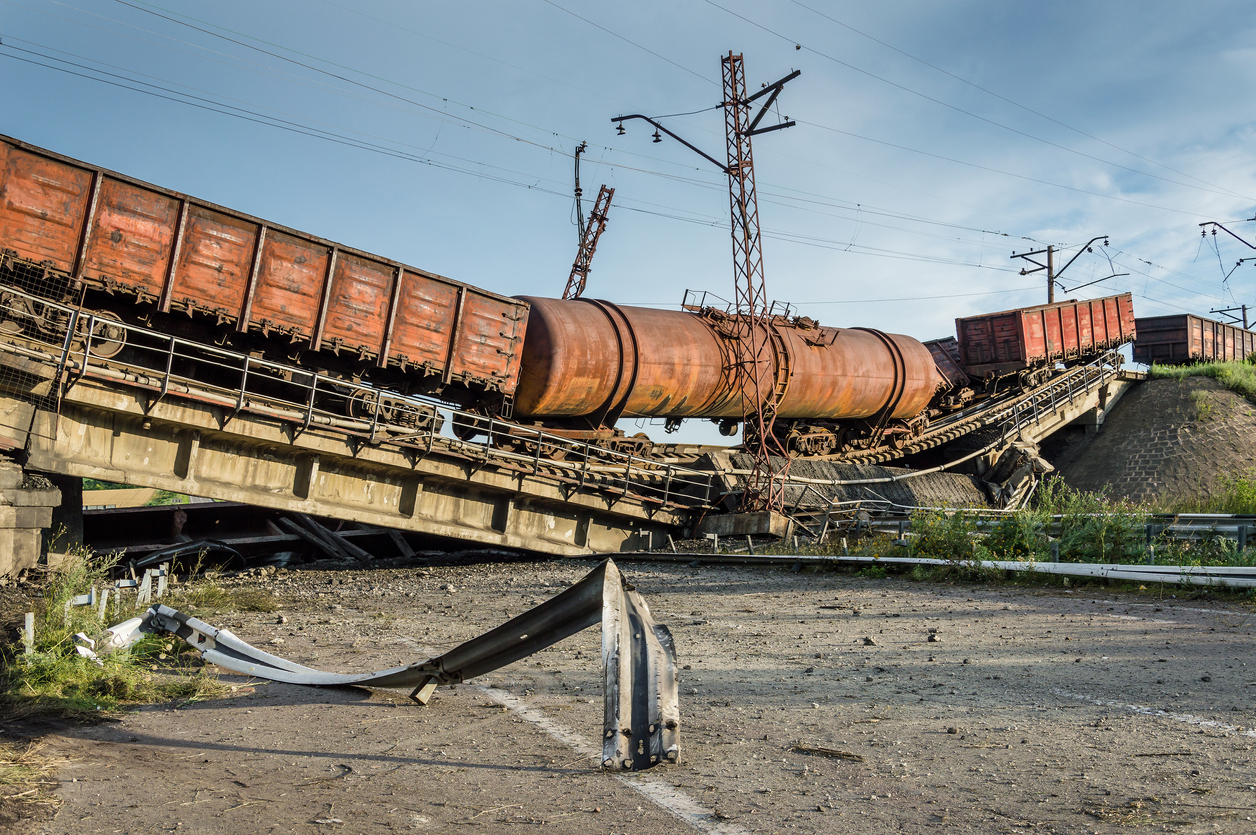
The meaning and relevance of (critical) infrastructure, its development, and its protection has been a recent area of political dispute (Photo: Dmytro Balkhovitin, licensed)
The research network investigates these meaning struggles in times of transition from an interdisciplinary perspective, combining multiple methods and drawing on historical and contemporary conflicts from different regions. The case studies range from struggles over the meaning of violence in the Weimar Republic and the significance of the Nuremberg Trials as a model for Argentina’s democratization to the role of ambiguity for foreign policy positions on Afghanistan and Western Sahara. Thereby, the network addresses pressing challenges that contemporary societies face, including transformations of the international order, responsibility for violence, and the influence of non-state actors.
Conflicts.Meanings.Transitions (formally “Bayerisches Zentrum für Friedens- und Konfliktforschung: Deutungskämpfe im Übergang“, 2022–2028) is funded by the German Federal Ministry of Research, Technology and Space (BMFTR).
By studying struggles over meaning in transitional processes, the research network connects regional sites of peace and conflict research in Bavaria. The participating institutions comprise the universities of Augsburg, Bayreuth, and Erlangen–Nuremberg (during the first funding phase, 2022–2026), as well as the Leibniz Institute of Contemporary History (IfZ) Munich–Berlin.
The cooperation aims to bring together and further develop interdisciplinary perspectives within a Bavarian Center for Peace and Conflict Research. With its focus on history and the social sciences, the network complements the predominantly political-science-oriented institutes of peace and conflict research in Germany. At the same time, it seeks to close the regional gap in this research field in Bavaria.
Furthermore, the network develops a broad range of activities for knowledge transfer to provide guidance in these times of rapid political change. It designs formats for multipliers, broader publics, and policymakers. For this, the regional network organizes workshops, lectures, and panel discussions, and uses social and traditional media as well as other outreach formats to communicate research findings. Early-career scholars – from students to postdoctoral researchers – also receive targeted support to promote sustainable knowledge transfer.
The network studies struggles over meaning and related transition processes within several thematic areas, which each bring together scholars from different institutions and disciplines. The main areas are disputes concerning the international order, universal rights, the role of non-state actors, and responsibility, especially for violence. The research uses a multimethod design that combines approaches from the humanities and social sciences with participatory methods. This allows the network to make both theoretical and practice-oriented contributions.
During the phase 2026–2028, the network focuses on the countervailing dynamics (“Gegenläufigkeiten”) of contemporary struggles over meaning. By this concept, the research studies the current backlash against the trend toward liberalism, democratization, and the rule of law that has shaped international politics since the 1990s. Struggles over meaning can reinforce such countervailing developments, with tangible consequences for peace. The network therefore examines how these conflicts unfold within increasingly polarized societies and in the context of shrinking civic spaces, and how this affects transition processes.
Moreover, the research enables varied knowledge-transfer activities to establish sustained structures for peace and conflict research in Bavaria. In the “City of Peace” Augsburg, the network supports events of the “Peace Academy” series as well as the annual Peace Summer Schools. These activities are now organized through the Transfer Center for Peace Augsburg ( Transferzentrum Frieden Augsburg, TFA), which the network helped establish. In Bayreuth, the network supports the Bayreuth Peace Talks and contributes to coordinating the newly established C³ – Conflict, Crisis, and Change Research Center.
The research also feeds into practice-oriented teaching programs and supervision of early-career scholars. Last but not least, the network provides demand-driven policy advice – through both policy papers and direct dialogue.
With its focus on interpretive approaches, the research network Conflicts.Meanings.Transitions addresses central questions of peace and conflict research and related disciplines.
Drawing on sociological, political science, and anthropological approaches, the network starts from the assumption that transitions between violent conflict and peace are often gradual and fluid. Historical peace and conflict research, too, increasingly focuses on processes of mobilization and demobilization rather than on clear-cut turning points such as declarations of war or ceasefires. Building on approaches from historical sciences, the network also examines interpretations of the past and the conflicts surrounding them. The aim is not to establish which interpretations of the past are historically accurate, but to analyze the influence of existing interpretations, processes of societal self-understanding, and disputes over visions of the future. Particular attention is paid to the interaction of power, violence, legitimacy, and memory in periods of political change.
Moreover, the research draws on conflict transformation and post-conflict peacebuilding studies. Transitional justice research, in particular, examines social disputes arising in transitional processes. So far, however, this field has focused primarily on the legal reckoning with past violence and the possible risks that such processes may pose to peace. At the same time, the network uses postcolonial and decolonial theories that seek to expose relations of domination and hidden forms of violence. From this perspective, transitions may also occur when new interpretations reveal previously “invisible” forms of violence or when past incidents of violence are reassessed.
In addition, Conflicts.Meanings.Transitions engages with current research in International Relations on transformations of the international order. This includes the study of foreign-policy decisions, transnational entanglements, and the role of international law and human rights.
The research network builds on the participating partners’ long-standing expertise in peace and conflict research as well as in communicating research to wider publics.
The research interests of the Chair of Political Science, Peace and Conflict Research at the University of Augsburg (Prof. Dr. Christoph Weller) include the causes and legitimization of violence. The Chair group draws on a broad understanding of violence encompassing physical, structural, cultural, and epistemic forms. In this context, the researchers also study cultures of remembrance, postcolonial perspectives, and the discursive negotiation of transitions. Their findings inform public events in the “City of Peace” Augsburg.
The Chair for Sociology of Africa at the University of Bayreuth (Prof. Dr. Jana Hönke), which hosts the network coordination, uses approaches from Global Political Sociology and International Relations to study practices of conflict. While its regional focus is on the Global South, particularly Africa, its research also considers transnational dimensions and global governance. The research conducted in Bayreuth examines the responsibility of multinational corporations for violence, the influence of African climate activists within the global climate movement, and the role of ambiguity – and efforts to avoid it – in international interventions and state-building processes. The chairholder, Prof. Dr. Jana Hönke, also directs the newly established C³ – Conflict, Crisis, and Change Research Center at the University of Bayreuth.
The Institute of Franconian Regional History at the University of Bayreuth is represented by PD Dr. Julia Eichenberg. She contributes perspectives from historical peace and conflict research, particularly on demobilization processes in postwar orders and regarding disputes over responsibility for violence.
The Leibniz Institute of Contemporary History Munich–Berlin (directed by Prof. Dr. Isabel Heinemann, previously by Prof. Dr. Andreas Wirsching) researches modern German history in its international and global contexts. Its work addresses a wide range of transitions, including those related to democratization, historical self-understanding, and transnational relations. The institute also contributes its research infrastructure (including its archive, library, digital resources, public outreach activities, and knowledge-transfer expertise) to the network.
The Chair of Modern and Contemporary History at the University of Erlangen–Nuremberg (Prof. Dr. Simone Derix, involved from 2022–2026) and the Center for Human Rights Erlangen–Nuremberg (CHREN) examine transnational actors, networks, and perceptions during periods of transition from a historical perspective. Particular attention is given to the history of human rights in Latin America.
The Chair of Modern and Contemporary History at the University of Augsburg (Prof. Dr. Dietmar Süß, involved from 2022–2026) applies approaches from the historical study of violence and conflict. Its work is based on the premise that violence is not the opposite of modern society but an integral part of it. In various projects, the Chair group examines experiences of violence and conflict, the use of scientific knowledge for warfare and peacebuilding, and the role of churches in violent conflicts.

